- Item

GENERAL
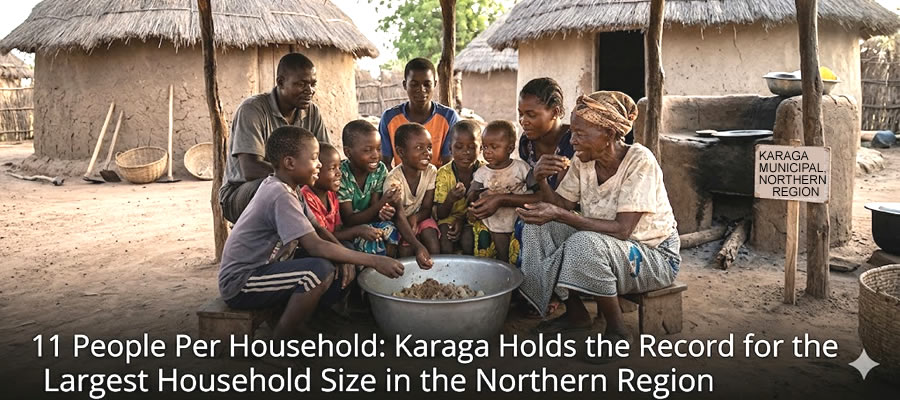
"11 People per Household: Karaga Holds the Record for the Largest Household Size in the Northern Region"
Date Created : 5/14/2026 : Story Author : Ernestina Mensah/Ghanandistricts.com
With 167 communities spread across an undulating savannah landscape, understanding who lives here and how they live is essential for planning health, education, water, and economic development.
The current population of Karaga Municipality is estimated at 77,706 from the 2010 Population and Housing Census, growing at a steady rate of 2.7%. By 2015, a survey conducted by Monitoring, Evaluation and Technical Support Services (METSS) under the Feed the Future Report recorded a total population of 85,794.
The following year, in April 2016, a survey by the District Health Directorate placed the population at 90,626. Official projections for 2018 estimate the population at 92,719, signaling a young, expanding population that will increasingly need schools, clinics, and job opportunities. At current growth rates, Karaga could cross the 100,000-resident mark by 2026–2027
Across multiple data sources, one pattern remains remarkably consistent: women outnumber men in Karaga Municipality. According to the 2010 census, females constituted 51.71% of the population while males made up 48.3%.
The 2016 Health Directorate survey recorded 46,432 females (51.23%) against 44,194 males (48.76%). The 2018 projection estimates 47,505 females compared to 45,214 males, while the 2015 METSS survey reported 44,572 females and 41,222 males.
This consistent female majority often signals male out-migration for labor opportunities, higher female life expectancy, or both. The implication is clear: development programs must prioritize women-focused initiatives such as shea processing, microfinance, maternal health services, and land tenure empowerment.
Here's a jaw-dropping stat: the largest average household size in the entire Northern Region during the 2010 census was recorded in Karaga Municipality a staggering 11.1 persons per household. By more recent estimates, the average household size for the Municipality sits at approximately 8 persons, with a total of 12,676 households across the Municipality.
The national average household size of 6.6 persons is notably lower than what Karaga experiences. The average household size in the Municipality is 6.6 persons, but considering that household sizes are generally larger in rural than in urban areas, the realistic average for Karaga's predominantly rural setting is closer to 8 persons.
What does this mean in practical terms? Large households mean more dependents per working adult, higher pressure on food and resources, and a greater need for family planning services, housing improvements, and diversified income sources.
Karaga Municipality is home to 167 communities, predominantly dispersed as rural homesteads with a few larger towns serving as market and administrative hubs. This scattered settlement pattern means that service delivery, whether health, education, or water must reach widely distributed populations.
The implication is clear: CHPS compounds, mobile health clinics, and reliable rural roads are not luxuries — they are necessities for connecting every community to opportunity.
However, Karaga faces real and persistent challenges. The poverty prevalence in the Municipality stands at 18.3%, which translates to approximately 15,700 people living below the poverty line.
The poverty depth measuring how far below the poverty line the average poor person falls is 5.5%, indicating that those in poverty are relatively close to the threshold but still struggle to meet basic needs.
Perhaps most concerning is that 9.2% of households experience moderate or severe hunger.
Other Stories


Local Gov Ministry
Int of Local Gov Studies
Ministry of Information
Local Gov Service
Ghana MPs
Ghana Hospitals
NALAG
 facebook
 X
X
 Youtube
 instagram
 whatsapp
 +233 593 831 280
+233 20 230 9497
+233 593 831 280
+233 20 230 9497 0800 430 430
 GPS: GE-231-4383
 info@ghanadistricts.com
 Box GP1044, Accra, Ghana