- Item


SOCIAL
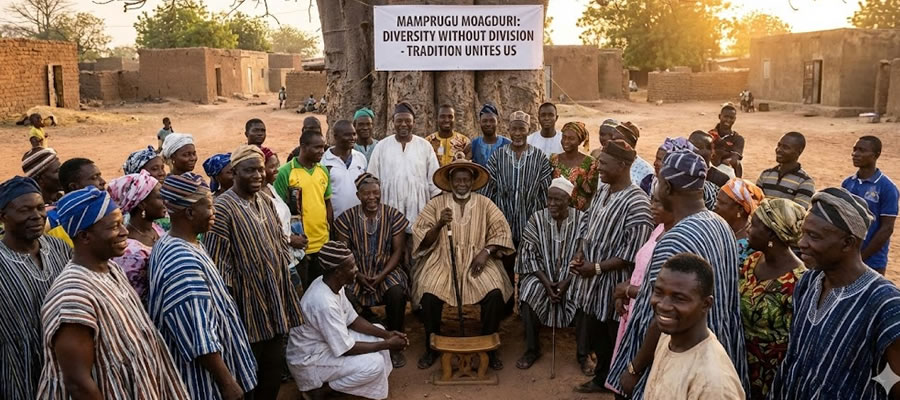
Diversity Without Division: Tradition Keeps Mamprugu Moagduri United
The Mamprugu Moagduri District is characterised by a rich mix of ethnic diversity and a deeply entrenched traditional political system that governs community life.
Date Created : 2/20/2026 : Story Author : Mary Ayertey/Ghanadistricts.com
The major ethnic groups in the district are the Mamprusis, Kantonsis, Komma, and Builsas, with Fulani settlers also present, many of whom are engaged as herdsmen by indigenous households. This diversity has shaped social relations and economic activities across the district.
Traditional authority is organised through a hierarchical system led by the Chief, supported by key office holders such as the Wudana (linguist), Kpandana (elders and advisers), Tindana (traditional priest), Kanbonnaba (chief warrior), Nachinaa (youth leader), Mangazia (women’s leader), and Fongu Kpamma (sectional heads).
The district comprises three main traditional areas—Wungu, Soo, and Wulugu—all of which fall under the jurisdiction of the Nayiri, the King of Mamprugu. Some communities in the West Mamprusi District share these traditional authorities, reflecting historical ties that predate current administrative boundaries.
With Islam as the predominant religion, cultural festivals such as Damba and Bugum remain central to community life. In addition to their religious significance, these festivals now serve as platforms for social mobilisation, conflict resolution, and political engagement, reinforcing the relevance of traditional authority in contemporary district development.
Other Stories
GoG Portal
Local Gov Ministry
Int of Local Gov Studies
Ministry of Information
Local Gov Service
Ghana MPs
Ghana Hospitals
NALAG
Local Gov Ministry
Int of Local Gov Studies
Ministry of Information
Local Gov Service
Ghana MPs
Ghana Hospitals
NALAG
 facebook
 X
X
 Youtube
 instagram
 whatsapp
 +233 593 831 280
+233 20 230 9497
+233 593 831 280
+233 20 230 9497 0800 430 430
 GPS: GE-231-4383
 info@ghanadistricts.com
 Box GP1044, Accra, Ghana