- Item

SOCIAL
Global Civil Society Statement on Child Labour in Cocoa June 12th, 2021
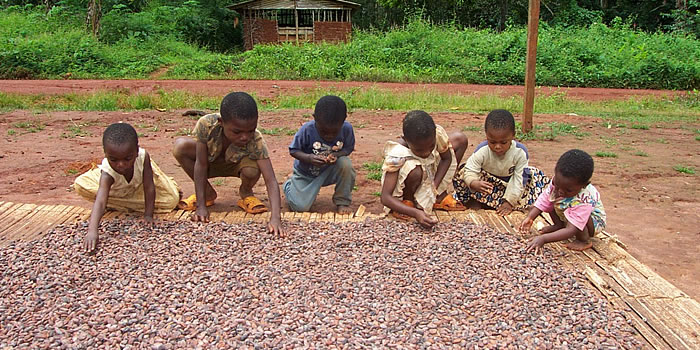
"Solidaridad and partners including Tropenbos Ghana, Ecocare Ghana and SEND Ghana have joined forces with global civil society to issue a statement on Child Labour in Cocoa."
Date Created : 6/12/2021 : Story Author : Solidaridad West Africa/Ghanadistricts.com
Read below the full statement:
Global Civil Society Statement on Child Labour in Cocoa June 12th, 2021
Today, June 12th is the International Day against Child Labour. On this day, as a large group of civil society organisations working on human rights in the cocoa sector across the world, we urgently call on chocolate & cocoa companies and governments to start living up to decades-old promises. The cocoa sector must come with ambitious plans to develop transparent and accountable solutions for current and future generations of children in cocoa communities.
This year marks the twentieth anniversary of the chocolate industry’s promise to end child labour in the cocoa sector of Ghana and Cote d’Ivoire, a commitment they made under the 2001 Harkin-Engel Protocol and renewed again with the 2010 Framework of Action. Furthermore, it is the International Year for the Elimination of Child Labour.
This year should have been a landmark in the fight against child labour in cocoa. Instead, the cocoa sector as a whole has been conspicuously quiet on this topic.
Child labour is still a reality on West African cocoa farms, and there is strong evidence that forced labour continues in the sector as well. Recent reports – such as Ghana’s GLSS 7 survey and the study of the University of Chicago commissioned by the United States government – show that close to 1.5 million children are engaged in hazardous or age-inappropriate work on cocoa farms in Ghana and Cote d’Ivoire. The vast majority of these child labourers are exposed to the worst forms of child labour, such as carrying heavy loads, working with dangerous tools, and increasing exposure to harmful agrochemicals.
After two decades of rhetoric, voluntary initiatives, and pilot projects, it is clearer than ever that ambitious, sector-wide action is needed, coupled with binding regulations, to address both child labour and the poverty that lies at its root.
These solutions must include regulations for mandatory human rights due diligence for companies operating in all major cocoa consuming countries, including avenues for legal remedy in those companies’ home countries. We note with interest the developments around regulations in the EU, although the announced delays are concerning. We also observe that the United States - the world’s number one cocoa consuming country - is particularly lagging in regulatory developments on this issue.
The industry, however, cannot use a lack of regulation as an excuse not to shoulder their own responsibility. As such, every chocolate and cocoa company should have a system in place that monitors and remediates child labour in all of their value chains with a child labour risk. The impact of these systems must be communicated publicly and transparently in a way that enables meaningful participation and access to remedy for workers and their representatives.
In parallel, effective partnerships between producer and consumer countries are needed to work on the necessary enabling environment. These must be developed in a much more inclusive manner than previous attempts, bringing in civil society organisations,
independent trade unions, local communities, and farmer representatives. Adequate resources must be provided to enable these local actors to participate as equals in the development and implementation of solutions. Child labour can only be effectively tackled if its root causes are also adequately addressed. As such, the cocoa sector must ensure that child labour approaches are deeply embedded into realistic and ambitious strategies to achieve a living income for all cocoa households. Such strategies must include the payment of fair and just remuneration at the farm gate; prices need to be sufficient to provide a living income. There are clear calculations available for Living Income Reference Prices, which are not even close to being met.
In all, this process must deliver time-bound and measurable action plans that are ambitious enough to cover the full scope of the challenge ahead.
It is time that the cocoa sector lived up to its promises and started to deliver on a sector-wide and ambitious plan to tackle child labour and poverty. The industry’s collective silence this year is shameful and inappropriate.
Signatories
• Fairtrade – Global • SÜDWIND-Institute – Germany
• Freedom United – Global • ISCC – Germany
• Oxfam – Global • EcoCare Ghana – Ghana
• Rainforest Alliance – Global • Global Media Foundation – Ghana
• VOICE Network – Global • SEND GHANA – Ghana
• World Fair Trade Organization – Global • Solidaridad West Africa – Ghana
• Be Slavery Free – Australia • Tropenbos Ghana – Ghana
• Südwind – Austria • Solidaridad – Netherlands
• ABVV/FGTB HORVAL – Belgium • Public Eye – Switzerland
• Fair Trade Advocacy Office – Belgium • Child Labour Coalition - United States
• COOPASA - Côte d'Ivoire • Fair World Project - United States
• Inades Formation - Côte d'Ivoire • Green America - United States
• ONG GAYA - Côte d'Ivoire • COOP Ecam - Côte d'Ivoire
• Mighty Earth - United States • Forum Fairer Handel e.V. – Germany
• INKOTA-netzwerk – Germany • The Human Trafficking Legal Center - United State
• International Rights Advocates - United States • SchokoFair-Stoppt Kinderarbeit! – Germany
• Indigenous Women Empowerment Network – Ghana • Conservation Alliance International – Ghana
• Réseau des Jeunes Entrepreneurs de Côte d'Ivoire (REJECI) - Côte d'Ivoire
Other Stories
GoG Portal
Local Gov Ministry
Int of Local Gov Studies
Ministry of Information
Local Gov Service
Ghana MPs
Ghana Hospitals
NALAG
Local Gov Ministry
Int of Local Gov Studies
Ministry of Information
Local Gov Service
Ghana MPs
Ghana Hospitals
NALAG
 facebook
 X
X
 Youtube
 instagram
 whatsapp
 +233 593 831 280
+233 20 230 9497
+233 593 831 280
+233 20 230 9497 0800 430 430
 GPS: GE-231-4383
 info@ghanadistricts.com
 Box GP1044, Accra, Ghana