- Item



- District Sublinks
- Other Links
- Other Officers
- Item
Physical and Natural Environment
i) Location and Size
The La Dade-Kotopon Municipal Assembly (LaDMA) is one of the 29 MMDAs in the Greater Region of Ghana situated in the South Eastern and diagonally located between Latitudes 5°32"50' N and Longitudes 0°11"15' W and Latitudes 5°38"0' N and Longitudes 0°7"50' W. It has a total land area of about 36 square km, which represents almost 1.1 percent of the total land size of the Greater Accra Region. It was carved from the Accra Metropolitan Assembly and was inaugurated on 28th June, 2012 with Legislative Instrument (LI) 2133.
The Municipality is bounded by the Korle Klottey Municipal Assembly to the West, and Ayawaso East and West to the North, the Ledzokuku Municipal Assembly to the East and the Gulf of Guinea to the South with La is the District capital. The location of the Municipality makes it economically viable for fishing, fish processing and subsistence farming. The cool breeze from the sea makes the area favourable for habitation. However, the corrosive nature of the breeze has put most facilities under deplorable states. Figure 1.2 shows LaDMA in Regional Context. 
ii) Climate
The LaDMA lies in the Coastal Savannah zone. The average annual rainfall is about 730mm. The first season begins in May and ends in mid-July while the second season begins in midAugust and ends in October. The Municipality occasionally experiences showers and thunderstorms in November and December. Rain usually falls in intensive short storms and gives rise to flooding where drainage channels are obstructed which leads to flooding.
The mean monthly temperature ranges from 24.7°C in August (the coolest) to 28°C in March (the hottest) with annual average of 26.8°C. Being close to the Equator, relative humidity is generally high varying from 65 percent in the mid-afternoon to 95 percent at night. The predominant wind direction in the Municipality is from the WSW to NNE. Wind speeds normally range between 8 to 16 km/hr. High wind gusts occur with thunderstorm activity, which pass in squall along the coast.
The maximum wind speed recorded in La is 107.4 km/hr (58 knots). Strong winds associated with thunderstorm activity often causes damage to property. Several areas within the Municipality experience micro climatic effects. Low profile drainage basins with a North-South orientation are not as well ventilated as those orientated East-West. Air is often trapped in pockets and an insulation effect gives rise to increase in air temperature.
iii) Vegetation Terrestrial Vegetation
There is evidence to suggest that the vegetation of the Municipal areas has been altered in the more recent past century by climatic and other human factors leaving a few remnant trees. Climatic change combined with the gradient of the plains and cultivation has imposed vegetation similar to those of the Southern Sahel, Sudan and Guinea Savannahs all of which lie North of the Accra plains. The coastal zone comprises of two vegetation types, wetland and dunes. The coastal wetland zone is highly productive and an important habitat for marine and terrestrial-mainly bird life. Mangroves, comprising of two dominant species, are found in the tidal zone of all estuaries sand lagoons. Salt tolerant grass species cover substantial low-lying areas surrounding the lagoons. These grasslands provide nutrients for prawns and fish in the lagoon.
In recent times, wetlands are however being encroached upon. Protection of the coastal wetland zone is very important to the long-term sustainability of the fishing industry. Coconuts and palms grow well in this zone, providing protection and also as economic crops. Most of the coconuts were planted in the 1920s but it is estimated that over 80 percent of those plantations have disappeared as a result of felling, disease and coastal erosion.
The loss of these trees is one of the principal reasons for the severity of erosion in some parts of the Municipality. In addition to the natural vegetation zones, a number of introduced trees and shrubs thrive in the Municipal area. Neems, mangoes, cassias, avocados, and palms are prominent trees on the Accra landscape. Introduced shrubs like bougainvillea are also very prominent. These are being damaged by encroachment, bush fire, sand winning and illegal tree felling. Most of the open spaces in the Municipal area are used for the cultivation of food crops like corn, okro, tomatoes and other vegetables. Fertilizers and insecticides are used in these areas.
The vegetation map can be found in Figure 1.3. Aquatic Vegetation These areas have increased as a result of erosion exposing the underlying bedrock. They aid in the provision of food and shelter for the survival of shrimps, prawns and many species of fin fishes. Ocean floor sea gases are confined to a few sheltered areas of the coastline and the lagoons. Aquatic Fauna The lagoon supports a wide range of crustacean, mollusks, gastropods, predatory and bottom feeding fish.
The lagoon is an important breeding ground giving adequate protection against large predator species and a continual supply of nutrients and organisms for food. The ocean supports a wide range of pelagic and bottom feeding fish. Common species are grouper, mackerel, cassava fish, African look down, sole shark and tiger fish. Stocks of off shore species have not been depleted. Evidence that suggests shore species are nearing exhaustion caused by excessive catching of small fish.
iv) Relief and Drainage
The drainage catchment area extends from the eastern boundary of the Nyanyanu catchment on the west of Greater Accra Regional boundary to Kpeshie Lagoon. The Kpeshie drainage basin covers a relatively small catchment area of 110 km2 . It covers the eastern part of Accra, Ridge, Cantonments, Osu, La and Burma camp.
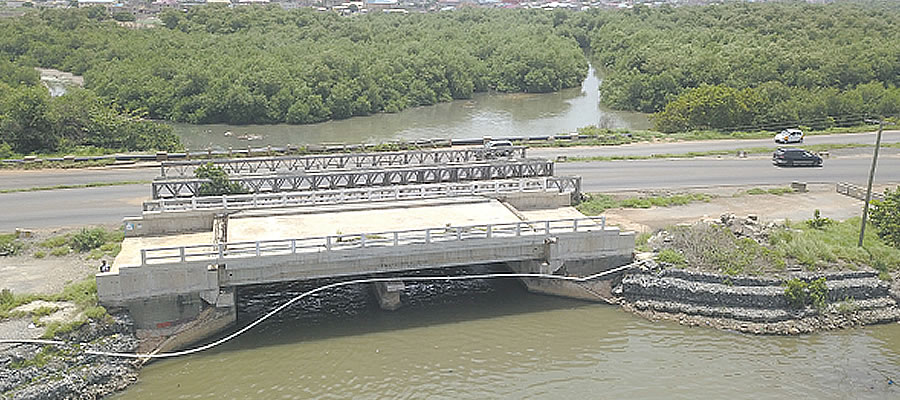
The Kpeshie Lagoon covers an area of approximately 2 km2 and closed by a sandbar except in the rainy season when it opens into the Gulf of Guinea eastwards of La Beach Hotel and La Palm Royal Beach Hotel. Streams in the catchment generally flow north to south, emptying directly into the principal outlet to the sea at Kpeshie Lagoon or the small Korle Lagoon at Osu. Drainage in the La Township is inadequate and many waterlogged areas become flooded with light rains. Plates 1 and 2 show the Kpeshie Lagoon and the Mangrove Forest around it and the physical development that is springing up along the stretch.
Plate 1 and 2 Physical Developments and Depletion of the Kpeshie Lagoon Mangrove The Kpeshie is fed by fresh water from two small streams that originate from East Legon and Accra – Tema Motorway. It also receives effluents from two sewage treatment plants as well as raw sewage from three storm drains. Other pollutants originate from drains, refuse dumps and diffuse sources including run-off from agricultural and commercial activities. The Kpeshie Lagoon has a fairly good cover of mangrove vegetation comprising principally the white mangrove Avicennia germinans with the button mangrove Conocarpus erectus as a minor component which serves as an important nursery ground for fishes and other marine lives. The mangrove cover, like many lagoons in Ghana, is under serious exploitation especially, from the northern section of the lagoon.
The lagoon has important birds especially, waterfowls and the sand dunes used to act as roosting sites for marine turtles which are protected species. With the current trend of pollution from refuse, all the fish species in the lagoon are under serious threat. The rapid loss of biodiversity poses a threat to humans as well. Solid waste threatens aquatic life through entanglement, suffocation and ingestion and a threat to tourism and general aesthetics. The eventual effect on the lagoon is heavy siltation and loss of biodiversity.
v) Soil, Geology and Minerals
The geology of the Municipality consists of Precambrian Dahomeyan Schists, Granodiorites, Granites Gneiss and Amphibolites to Precambrian Togo Series comprising mainly of Quartzite, Phillites, Phylitones and Quartz Breccias. Other formations found are the Palaeozoic Accraian Sediments-Sandstone, Shales and Interbedded Sandstone-Shale with Gypsum Lenses.
The coastline of La has a series of resistant rock outcrops and platforms and sandy beaches near the lagoons which cause drainage problems. The soils in the Municipal area can be divided into four main groups:
• Drift materials resulting from deposits by windblown erosion;
• Alluvial and marine motted clays of comparatively recent origin derived from underlying shales;
• Residual clays and gravels derived from weathered quartzites, gneiss and schist rocks; and
• Lateritic sandy clays soils derived from weathered Accraian sandstone bedrock formations
Biodiversity, Climate Change, Green Economy and the Environment Climate change and variability may affect people negatively depending on their ability to cope with the changing situations. The Municipality is experiencing adverse effects from climate change in the areas of flooding, reduced agricultural activities, land degradation, siltation in water bodies, loss of aquatic lives and pollution in all forms; air, water and noise.
Human activities that have contributed to these in Municipality include conversion of open spaces into the construction of physical structures, removal of trees and vegetative cover, sand winning at the beach and conversion of arable lands into sites for construction. Other causes are the emission of gases from motor vehicles, the burning of waste and other improper waste disposal methods leading to rise in temperature, flooding and the influx of diseases. This plan intends to increase advocacy programmes and awareness creation on climate change as well as construction of drains to flooding and also ensure that all programmes implemented will lead to greening of the local economy.
Natural and Man-Made Disasters
The Kpeshie Lagoon has been extensively damaged by man-made activities leading to extensive floods during the rainy season. Drainage in the La Township is inadequate and many waterlogged areas become flooded with light rains. In heavy rains, fence walls collapse and foundations are exposed. As the Municipality expands and surface water runoff increases there will be a corresponding increase in siltation and more severe floods downstream, especially in areas surrounding the lagoons. Figure 1.4 shows the flood prone areas within the Municipality.
The major cause of this flooding is the dumping of waste into drains. If this situation is to be avoided, conservation measures will have to be applied to reduce the rate of runoff. The severest areas are New Lakpanaa and Abafum/Kowe/Abese. Another possible cause of manmade disasters is the existence of old buildings which become death traps as they continue to age and this adds to the number of fire outbreaks as a result of poor wiring.
Date Created : 9/25/2025 7:45:58 AM





Local Gov Ministry
Int of Local Gov Studies
Ministry of Information
Local Gov Service
Ghana MPs
Ghana Hospitals
NALAG
 facebook
 X
X
 Youtube
 instagram
 whatsapp
 +233 593 831 280
+233 20 230 9497
+233 593 831 280
+233 20 230 9497 0800 430 430
 GPS: GE-231-4383
 info@ghanadistricts.com
 Box GP1044, Accra, Ghana