- Item


GENERAL
Asutifi North’s Rich Semi-Deciduous Belt in the Balance
Date Created : 1/23/2026 : Story Author : Ernestina Mensah/Ghanandistricts.com
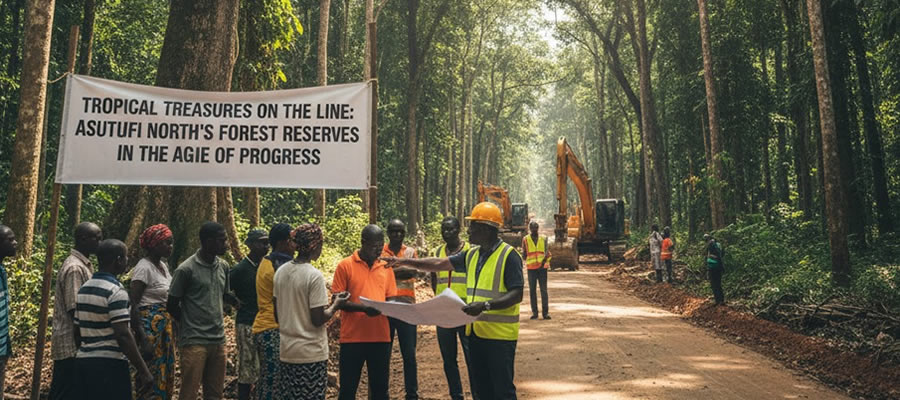
Yet, as development accelerates, the district’s verdant cover faces mounting pressures from human activity. Forest reserves now span 475.63 square kilometers of the district, underscoring both the abundance of green assets and the urgent need for sustainable stewardship.
The district’s vegetation sits within a humid semi-deciduous zone, supporting a mosaic of evergreen and deciduous trees that are highly valued for construction, furniture, and traditional crafts. Wawa and Odum are among the standout species, renowned for durability and market demand.
Other notable hardwoods—Esa, Kyenkyen, Ofram, and Fununtum—add to the district’s timber portfolio while contributing to the ecological richness of the region. This wealth not only fuels local livelihoods but also anchors biodiversity, watershed protection, and climate resilience.
Several protected forest areas form the backbone of Asutifi North’s green economy. The Biaso Shelter Belt serves as a critical buffer against erosion and wind, safeguarding soils and agricultural lands nearby. The Bia-Tano Forest Reserve, with its diverse habitat, supports wildlife and watershed health. The Asukese Forest Reserve adds to the district’s green shield, while the Amama Shelter Belt forest stands as another strategic conservation corridor.
Collectively, these reserves cover a substantial portion of the district’s land area, reflecting a commitment to balancing development with conservation.
Despite the abundance of forest resources, the district grapples with the environmental and socio-economic impacts of deforestation, illegal logging, and encroachment. Unsustainable extraction can threaten biodiversity, undermine soil quality, and impair water cycles.
Conversely, well-managed forest lands offer a host of benefits: revenue from timber and non-timber forest products, tourism potential, watershed protection, and job creation in forest management, monitoring, and eco-friendly enterprises.
Experts and community leaders emphasize a multi-pronged approach to safeguard Asutifi North’s forests in the area of strengthened governance by clear zoning, enforceable forest laws, and transparent permit systems to curb illegal activities.
Through community-based stewardship in involving local communities in monitoring, benefit-sharing, and sustainable harvesting practices can lead to sustainable value chains by promoting certified timber, agroforestry, and non-timber forest products to diversify income while reducing pressure on primary forests.
With environmental education, building awareness about the ecological and economic value of forests to foster responsible stewardship can serve as one of the comprehensive approaches to safeguard the Asutifi North’s forests
Healthy forests are foundational to the district’s resilience and growth. They support water quality, soil stability, and climate adaptation for surrounding farms. At the same time, communities depend on forest resources for livelihoods—from timber and carpentry to medicinal plants and artisanal crafts.
Ensuring sustainable management will help preserve these income streams while enabling growth in related sectors like ecotourism and community forestry initiatives.
Other Stories









Local Gov Ministry
Int of Local Gov Studies
Ministry of Information
Local Gov Service
Ghana MPs
Ghana Hospitals
NALAG
 facebook
 X
X
 Youtube
 instagram
 whatsapp
 +233 593 831 280
+233 20 230 9497
+233 593 831 280
+233 20 230 9497 0800 430 430
 GPS: GE-231-4383
 info@ghanadistricts.com
 Box GP1044, Accra, Ghana