- Item




PHYSICAL CHARACTERISTICS
Location and Size
Ablekuma Central Municipal Assembly lies between Longitude 05°38'N and on Latitude 00°60'W with a land size of 13.28 km2. It shares boundaries with Ga Central Municipal Assembly (GCMA) to the North, Ablekuma West Municipal Assembly to the South, Okaikoi North Municipal Assembly in the East, and Weija- Gbawe Municipal Assembly to the West. The location of the Municipality is strategic, straddling the commercial, industrial and residential parts of Accra.
Geology
The geology of the ANMA consists of Precambrian Dahomeyan Schists, Granodiorites, Granites Gneiss and Amphibolites to late Precambrian Togo Series comprising mainly Quartzite, Phillites, Phylitones and Quartz Breccias. Other formations found are the Palaeozoic Accraian Sediments - Sandstone, Shales and Interbedded Sandstone-Shale with Gypsum Lenses.
The soils in the Municipality can be divided into three main groups: drift materials resulting from deposits by windblown erosion; residual clays and gravels derived from weathered quartzites, gneiss and schist rocks, and lateritic sandy clay soils derived from weathered Accraian sandstone bedrock formations. In many low lying poorly drained areas, pockets of alluvial ‘black cotton’ soils are found.
These soils have a heavy organic content, expand, and contract readily causing major problems with foundations and footings. In some areas, lateritic soils are strongly acidic and when saturated are prone to attack concrete foundations causing honeycombs. Near the foothills are the large areas of alluvial laterite gravels and sands. Many of these deposits are being won for constructional purposes.
These soils have a heavy organic content, expand, and contract readily causing major problems with foundations and footings. In some areas, lateritic soils are strongly acidic and when saturated are prone to attack concrete foundations causing honeycombs. Near the foothills are the large areas of alluvial laterite gravels and sands. Many of these deposits are being won for constructional purposes.
Climate
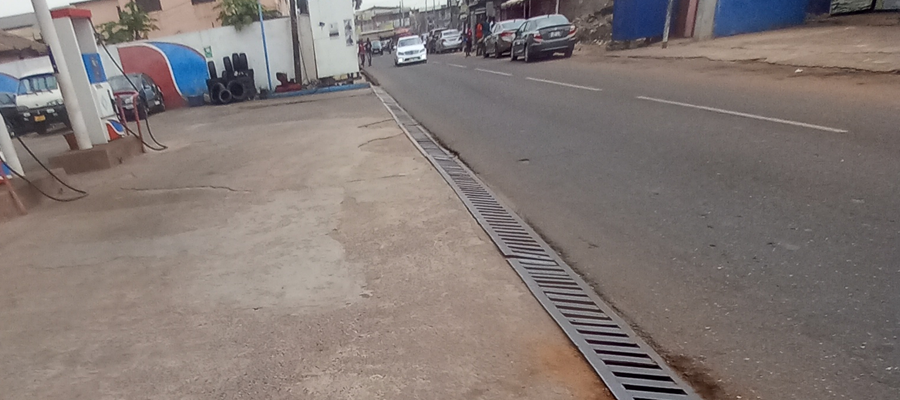
The Ablekuma Central Municipal Assembly lies in the Coastal Savannah zone. There are two rainy seasons. The average annual rainfall is about 730mm, which falls primarily during the two rainy seasons. The first begins in May and ends in mid-July. The second season begins in mid-August and ends in October. Rain usually falls in intensive short storms and gives rise to local flooding where drainage channels are obstructed.
There is very little variation in temperature throughout the year. The mean monthly temperature ranges from 24.7°C in August (the coolest) to 28°C in March (the hottest) with annual average of 26.8°C. As the area is close to the equator, the daylight hours are practically uniform throughout the year. Relative humidity is generally high varying from 65% in the mid-afternoon to 95% at night.
Vegetation
As a highly urban area with massive built environment, vegetation cover is not apparent.
There is evidence to suggest that the vegetation of the Municipality has been altered in the more recent past century by climatic and other human factors. Much of the municipality was believed to have been covered by savanna with scattered trees of which only a few remnant trees survive. There are two broad vegetation zones in Ablekuma Central Municipal Assembly, which comprise shrub land and grassland lands. Only the shrub land occurs more commonly in the western outskirts of the Municipality. It consists of dense clusters of small trees and shrubs, which grow, to an average height of five metres (5m). The grasses are mixture of species found in the undergrowth of forests.
They are short, and rarely grow beyond One metre (1m). Ground herbs are found on the edge of the shrub.
The Municipality is bordered on its southwestern zone by the Densu River estuary system which is a major ecological zone and has significant natural flood controlling function as well as major habitat for flora and fauna. The estuary serves as the flood plain of many parts of Accra and also absorbs water spillage from the Weija Dam.
The Municipality considers this ecosystem an important one and has made it a priority to continue its preservation. It is threatened by encroachment and physical development as the pressure on residential lands in the Municipality and other parts of Accra pushes
The Municipality considers this ecosystem an important one and has made it a priority to continue its preservation. It is threatened by encroachment and physical development as the pressure on residential lands in the Municipality and other parts of Accra pushes
people to marginal lands.
Electoral Areas and Communities
The Municipality is constituted by Seven (7) Electoral Areas
i. Mataheko
ii. Shukura West
iii. Shukura East
iv. Mamprobi
v. Russia
vi. Abbosey Okai
vii. Sabon Zongo
Each electoral area is represented by one elected Assembly member.
As a highly urban areas the communities that make up the contagious municipality
include the following ;
i. Mataheko
ii. Shukura
iii. Mamprobi
iv. Russia
v. Abbosey Okai

Date Created : 5/21/2025 12:00:00 AM




GoG Portal
Local Gov Ministry
Int of Local Gov Studies
Ministry of Information
Local Gov Service
Ghana MPs
Ghana Hospitals
NALAG
Local Gov Ministry
Int of Local Gov Studies
Ministry of Information
Local Gov Service
Ghana MPs
Ghana Hospitals
NALAG
 facebook
 X
X
 Youtube
 instagram
 whatsapp
 +233 593 831 280
+233 20 230 9497
+233 593 831 280
+233 20 230 9497 0800 430 430
 GPS: GE-231-4383
 info@ghanadistricts.com
 Box GP1044, Accra, Ghana