- Item


ECONOMICS
Calls for Healthy global cooperation for resilient economies climax IMF/WBG meetings
The International Monetary Fund (IMF)/World Bank Group (WBG) 2023 Annual Meetings in Marrakech ended with a reverberating call for global cooperation and solidarity to build robust economies, especially, vulnerable and low and middle-income countries.
Date Created : 10/16/2023 : Story Author : Francis Ntow/Ghanadistricts.com
Officially, the meetings closed on Sunday, October 15, 2023, and the Marrakech Principle was adopted, as debt restructuring, climate and changes to the global financial architecture became the highlight of discussions all week long.
The Marrakech Principle serves as a blueprint for enhanced global cooperation and action on common challenges to build resilience and expand opportunities for a better future.
Although a new plan for increasing funding by the IMF was not reached, a call was made by the Steering Committee Chair for a quota contribution to at least keep the current financial cover of US$185 billion in borrowings.
The World Bank governing body could not issue a joint communique on the meetings, but its Development Committee approved the Bank’s vision “to create a world free of poverty on a liveable planet.”
Meanwhile, Africa had the nod to have a third Chair on the IMF Executive Board to make their voice vocal, as the funds increased its Board members from 24 to 25, though quotas remained the same.
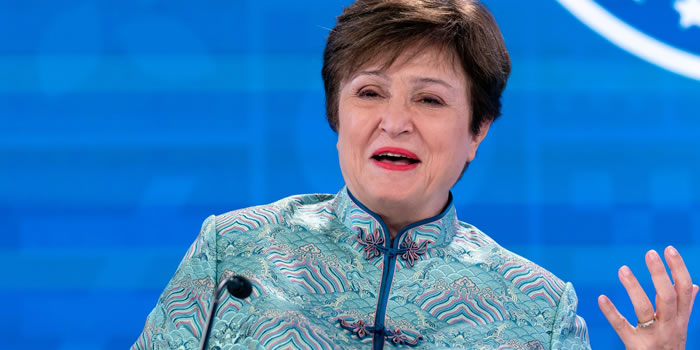
Ms. Kristalina Goergieva, Managing Director, of IMF, said: “We recognize that these are the most vulnerable countries that are at highest risk in this very turbulent environment.”
That, she said, had made demands for the Fund’s support for low-income countries and vulnerable middle-income countries hit a record high.
“To be able to provide meaningful support, we need more resources for our Poverty Reduction and Growth Trust (PRGT). It is time for solidarity, but solidarity when there’s so much tension is hard to build, yet, we’ve succeeded in doing so,” Ms Goergieva said.
Mr. Ajay Banga, World Bank President, said the institution would “export optimism and impact,” by working together with all forces, including multilateral banks, and philanthropies, and to make lives better around the world.
“We need the skills, resources, and ingenuity of the private sector. There’s nothing that gives me more hope than our capacity to work together in common purpose,” Mr. Banga said.
“Given the situation we’re living in, this statement provides guidance precisely along the lines of hope,” said Mr. Abdellatif Jouahri, Governor of Bank Al-Maghrib, Morocco.
“In order words, we’re trying to deal with a situation where we need to pull together, limit the extent of the fragmentation and the damage it causes,” he explained.
“We also need to get back on track in terms of climate resilience because people are now becoming aware that we’ve opened the gates of hell and we need to close those gates as soon as possible,” Mr. Jouahri said.
He called for urgency in addressing poverty, strengthening the fight against exclusion, and integrating women and their role in the economy, particularly in Africa, which would become a driver of future economic activities.
For Mr. Sheku Bangura, Minister of Finance, Sierra Leone, the current global economic crisis and fragmentation, had become more important for global multilateral finance and development to deepen their support to countries.
“We need to ensure that institutions like the Bank and the Fund, when we’re recalibrating our programs to take care of systems to deliver more services for poor people within our governments, they’re on our back,” he said.
Ghanaian authorities, led by Mr. Ken Ofori-Atta, Finance Minister, in the company of Dr Ernest Addison, Governor, Bank of Ghana (BoG), used the occasion to strike various deals.
At the end of the meetings, Ghana gained assurances from China and France – Co-Chairs, Official Creditors Committee, expected to lead to the signing of a pact for debt restructuring in a few weeks.
This is to pave the way for IMF Executive Board approval for a second tranche of US$600 million [part of the Fund’s US$3bn loan] for Ghana’s Post-COVID-19 Programme of Economic Growth (PC-PEG) implementation.
“Action is needed from the creditors’ side; Ghana has done its fair share, and it’s for creditors to take the next steps, and we’re not going to ask the government to do more adjustment because creditors haven’t asked either,” Mr. Abebe Aemro Selassie, Director, African Department, IMF, said earlier last week.
The World Bank’s International Finance Corporation (IFC), also pledged financing support to Ghana’s implementation of various climate change schemes, to stimulate sustainable growth, a liveable planet, and create more jobs for people.
Characteristic of the IMF/WBG Annual Meetings, there were a series of meetings and debates, capacity building, and release of various policy documents, including the World Economic Outlook.
This was the second time that the meetings, rotated every three years from Washington, were held on African soil.
Prior to Morocco hosting this year’s IMF/WBG Annual Meetings, Kenya first held the meetings in Africa some 50 years ago in 1973.
Other Stories

GoG Portal
Local Gov Ministry
Int of Local Gov Studies
Ministry of Information
Local Gov Service
Ghana MPs
Ghana Hospitals
NALAG
Local Gov Ministry
Int of Local Gov Studies
Ministry of Information
Local Gov Service
Ghana MPs
Ghana Hospitals
NALAG
 facebook
 twitter
 Youtube
 +233 593 831 280
+233 20 230 9497
+233 593 831 280
+233 20 230 9497 0800 430 430
 GPS: GE-231-4383
 info@ghanadistricts.com
 Box GP1044, Accra, Ghana