- Item

SOCIAL
BEWDA empowers communities to advocate for climate-resilient WASH facilities

Date Created : 9/25/2026 12:00:00 AM : Story Author : Anthony Adongo Apubeo/Ghanadistricts.com
The initiative seeks to equip community advocates with the skills to identify and document the impacts of climate change on WASH, mobilise their communities and engage authorities and other stakeholders to address the challenges.
The project, dubbed “Civil Society Leadership Mobilising for Better WASH Project,” is funded by the Swedish International Development Cooperation Agency (SIDA) through WaterAid Ghana, a WASH-focused organisation.
Currently, BEWDA and its partners are working towards training at least 100 community advocates across five districts and municipalities in the region, including Nabdam, Bongo, Kassena-Nankana West, Bawku West and Kassena-Nankana Municipality.
The main objective is to build a movement of community advocates capable of generating evidence, engaging duty bearers and sustaining advocacy for solutions to climate change-related challenges affecting WASH and community development.
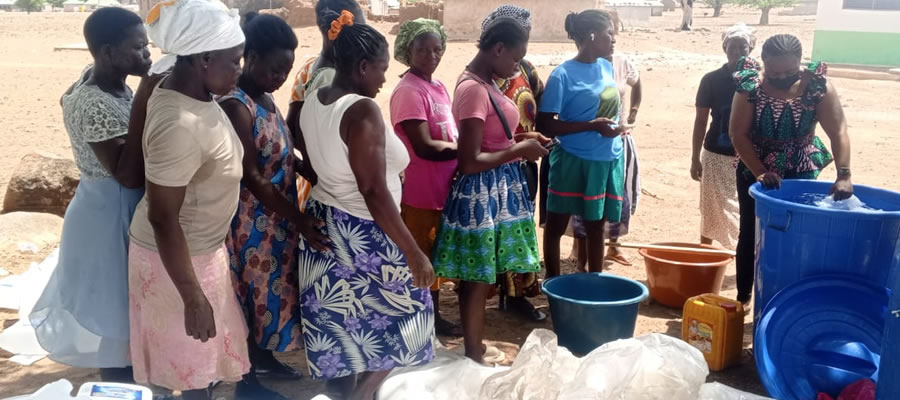
Mr Sebastian Agumah Mbabugri, Project Lead of BEWDA, said this during an engagement with community climate change advocacy champions from Nayorigo and Zorko-Awaa communities in the Bongo District.
He said climate change had become a reality that communities experienced regularly, making it necessary to build their capacity to identify its impacts and lead efforts to strengthen community resilience.
“Our duty as civil society in mobilising our communities and the people that we serve in solving climate change-related problems and the impact of climate change on WASH and other related activities is for us to closely work with the communities and build the capacities of our communities to be able to lead the change that we want for better WASH,” he said.
Mr Mbabugri said the training was designed to equip selected community members with the skills to generate evidence on the impact of climate change on WASH and use such evidence to engage duty bearers, civil society organisations and development agencies.
He said the programme was also intended to enable communities to identify ways of adapting to and mitigating the effects of climate change while ensuring that vulnerable groups were protected.
He explained that the communities had been introduced to a scorecarding tool to enable the champions to assess WASH challenges from the community's perspective and generate evidence that could be used in wider community engagements.
Mr Emmanuel Abariga, Head of Programmes at BEWDA, said duty bearers had a responsibility to establish systems and provide facilities that protected communities and vulnerable groups from the effects of climate change.
He therefore urged the champions to hold duty bearers accountable for addressing climate-related challenges confronting their communities.
He identified assembly members, unit committee members, chiefs and elders, District Chief Executives, Regional Ministers and Members of Parliament, among others, as duty bearers at various levels because of their ability to influence decisions and facilitate development.
He said authorities must pay greater attention to the provision of appropriate WASH facilities in schools and health facilities, adding that addressing WASH gaps would contribute to quality healthcare and community development.
Ms Blessing Aloko, a resident of Nayorigo, said about 90 per cent of households in the community did not have household latrines, compelling residents to practise open defecation.
She pledged to lead advocacy efforts to help address the situation.
Ms Kate Agana, a resident of Zorko-Awaa, also commended BEWDA for the training and said women in some communities travelled for nearly an hour in search of water.
She appealed for support to provide additional water sources for the community.
Related News Headlines
Local Gov Ministry
Int of Local Gov Studies
Ministry of Information
Local Gov Service
Ghana MPs
Ghana Hospitals
NALAG
 facebook
 X
X
 Youtube
 instagram
 whatsapp
 +233 593 831 280
+233 20 230 9497
+233 593 831 280
+233 20 230 9497 0800 430 430
 GPS: GE-231-4383
 info@ghanadistricts.com
 Box GP1044, Accra, Ghana