- Item

EDUCATION
Education Hub Struggles as 39% of Pupils in Mampong Stay Out of School
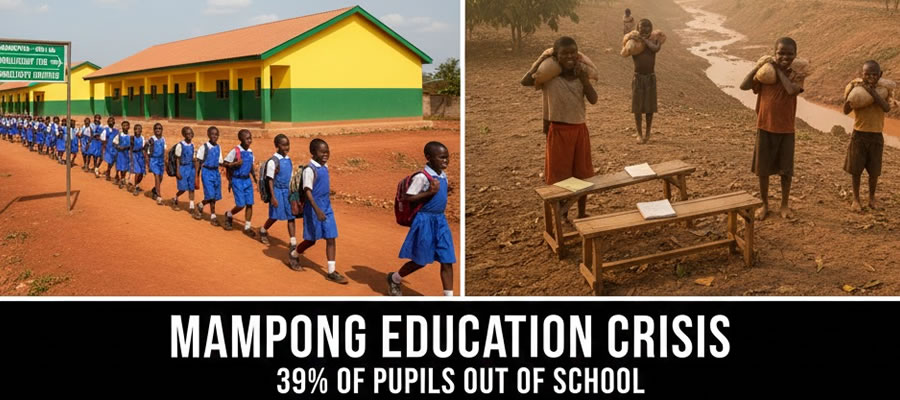
The Mampong Municipality though has established itself as one of the most significant educational centers in the Ashanti Region, the most alarming statistic is that 39% of pupils of school-going age are out of school.
Date Created : 12/4/2025 12:00:00 AM : Story Author : Ghanadistricts.com
This figure highlights the urgent need for intervention to ensure that children are not denied the opportunity to learn. Poverty, lack of support for vulnerable families, and limited access to scholarships are among the key factors driving this situation. Without decisive action, the municipality risks undermining the potential of its youth and slowing down socio-economic development.
With a wide network of schools and training institutions, the area provides opportunities for learning at all levels, from basic education to tertiary training. The municipality currently hosts 85 Primary Schools, 58 Junior Secondary Schools, 4 Senior Secondary Schools, and 1 Vocational School, ensuring that children across communities have access to foundational education.
Despite this impressive infrastructure, the quality of education in Mampong faces serious challenges. Financial constraints have limited resources for schools, affecting teaching standards and learning outcomes. Many institutions struggle with inadequate facilities, insufficient teaching materials, and overcrowded classrooms. These issues have contributed to discouraging performance levels, raising concerns among parents, educators, and policymakers.
Beyond basic schooling, Mampong has invested heavily in professional and tertiary education. The municipality is home to two Teacher-Training Colleges, a Midwifery Training School, a Health Assistant’s Training School, and a University. These institutions not only serve the local population but also attract students from neighboring districts and regions, positioning Mampong as a hub for human capital development. Indeed, more than 80% of post-Junior High School institutions in the area are located within the municipality, underscoring its importance in shaping Ghana’s educational future.
Stakeholders, including government agencies, local authorities, and community leaders, are being called upon to address these challenges.
Investment in infrastructure, teacher training, and financial support for families could help bridge the gap. Expanding scholarship schemes and strengthening community-based initiatives may also provide relief, ensuring that every child in Mampong has the chance to benefit from education.
The future of Mampong Municipality lies in its ability to harness its educational potential.
With its extensive network of schools and training institutions, the area has the capacity to produce skilled professionals who can contribute to national development. However, this vision can only be realized if the challenges of access and quality are tackled head-on. Education remains the cornerstone of progress, and for Mampong, it is both a promise and a responsibility that must be fulfilled.
With its extensive network of schools and training institutions, the area has the capacity to produce skilled professionals who can contribute to national development. However, this vision can only be realized if the challenges of access and quality are tackled head-on. Education remains the cornerstone of progress, and for Mampong, it is both a promise and a responsibility that must be fulfilled.
Related News Headlines



GoG Portal
Local Gov Ministry
Int of Local Gov Studies
Ministry of Information
Local Gov Service
Ghana MPs
Ghana Hospitals
NALAG
Local Gov Ministry
Int of Local Gov Studies
Ministry of Information
Local Gov Service
Ghana MPs
Ghana Hospitals
NALAG
 facebook
 twitter
 Youtube
 +233 593 831 280
+233 20 230 9497
+233 593 831 280
+233 20 230 9497 0800 430 430
 GPS: GE-231-4383
 info@ghanadistricts.com
 Box GP1044, Accra, Ghana