- Item


AGRICULTURE
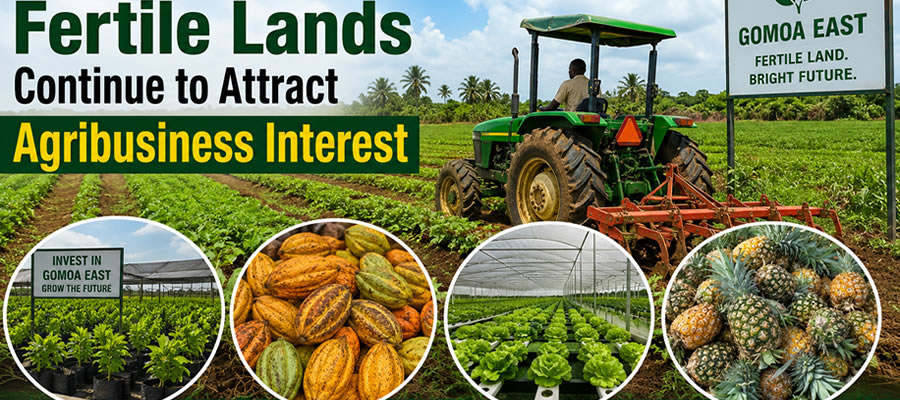
Gomoa East’s Fertile Lands Continue to Attract Agribusiness Interest
Date Created : 12/16/2025 12:00:00 AM : Story Author : Ernestina Mensah/Ghanandistricts.com
Agriculture currently employs more than 60 percent of the Municipality’s labour force, making it the single largest economic activity in the area. With an estimated 169.25 square kilometres of agricultural land, Gomoa East continues to attract attention for its fertile lands, diverse crop production, and expanding agribusiness opportunities.
Gomoa East’s Fertile Lands Drive Massive Crop Production
The Municipality’s favourable ecology supports the cultivation of several staple and cash crops including cassava, maize, sugar cane, pineapple, rice, pawpaw, yam, plantain, vegetables, and citrus fruits. Farmers in the district are also increasingly venturing into non-traditional export crops such as Asian vegetables, chilly pepper, bird eye pepper, and pineapple production.
Local agricultural experts say the Municipality’s rich soil and suitable climate conditions have positioned Gomoa East as a promising destination for commercial farming and agro-processing investments.
Fishing Industry Supports Thousands of Livelihoods Beyond crop farming, the fishing industry continues to play a major role in sustaining livelihoods across coastal communities in the Municipality. Marine fishing alone employs approximately 8,000 men and 3,000 women, making it one of the largest employment sectors in the local economy.
Communities around Okyereko and Adzintem are also gradually exploring fish farming and small-scale aquaculture to diversify income sources and improve food security.
Poultry Sector Records Steady Growth Poultry farming is emerging as one of the district’s fastest-growing agricultural subsectors. Although it currently employs about 2 percent of the workforce, stakeholders believe the sector has enormous potential to create jobs, improve nutrition, and support local economic growth.
Thousands Depend on Agriculture in Gomoa East Available data indicates that farming activities in the district employ about 12,075 people, with males accounting for 60 percent of the workforce while females make up 40 percent
.
Despite the sector’s dominance, agricultural production in the district remains largely subsistence-based, with many farmers operating on small-scale farms. However, development experts believe increased investment in mechanisation, irrigation, storage facilities, and access to markets could significantly transform the sector.


Local Gov Ministry
Int of Local Gov Studies
Ministry of Information
Local Gov Service
Ghana MPs
Ghana Hospitals
NALAG
 facebook
 X
X
 Youtube
 instagram
 whatsapp
 +233 593 831 280
+233 20 230 9497
+233 593 831 280
+233 20 230 9497 0800 430 430
 GPS: GE-231-4383
 info@ghanadistricts.com
 Box GP1044, Accra, Ghana